A treadmill sounds like a single purchase until it arrives at your door. Then it becomes a room-planning decision, a delivery-path decision, a noise decision, and a household-routine decision. That is especially true with Sole treadmills. These are not thin walking pads that disappear under a couch. They are substantial folding machines built around durable frames, full-length decks, and subscription-free use.
This Sole treadmill fit guide is for the buyer who has already decided to look at Sole, but is unsure whether the F63, F80, or F85 fits the home. The short answer: the F63 is the value pick for walking and light running, the F80 is the safer middle choice for shared homes and regular runners, and the F85 is the upgrade for heavier use, decline training, and a bigger built-in screen.
Scope note: this guide uses public product information from the official Sole F63, F80, F85, and treadmill collection pages checked on June 11, 2026, plus independent editorial coverage from Good Housekeeping and SELF. We did not perform a first-hand lab test, so comfort, noise, setup, and service experience are treated as source-backed signals rather than personal testing claims. For how we handle reviews, see our /editorial-policy/ and /about/ pages.
Sole Treadmill Fit Guide: Start With the Room, Not the Model
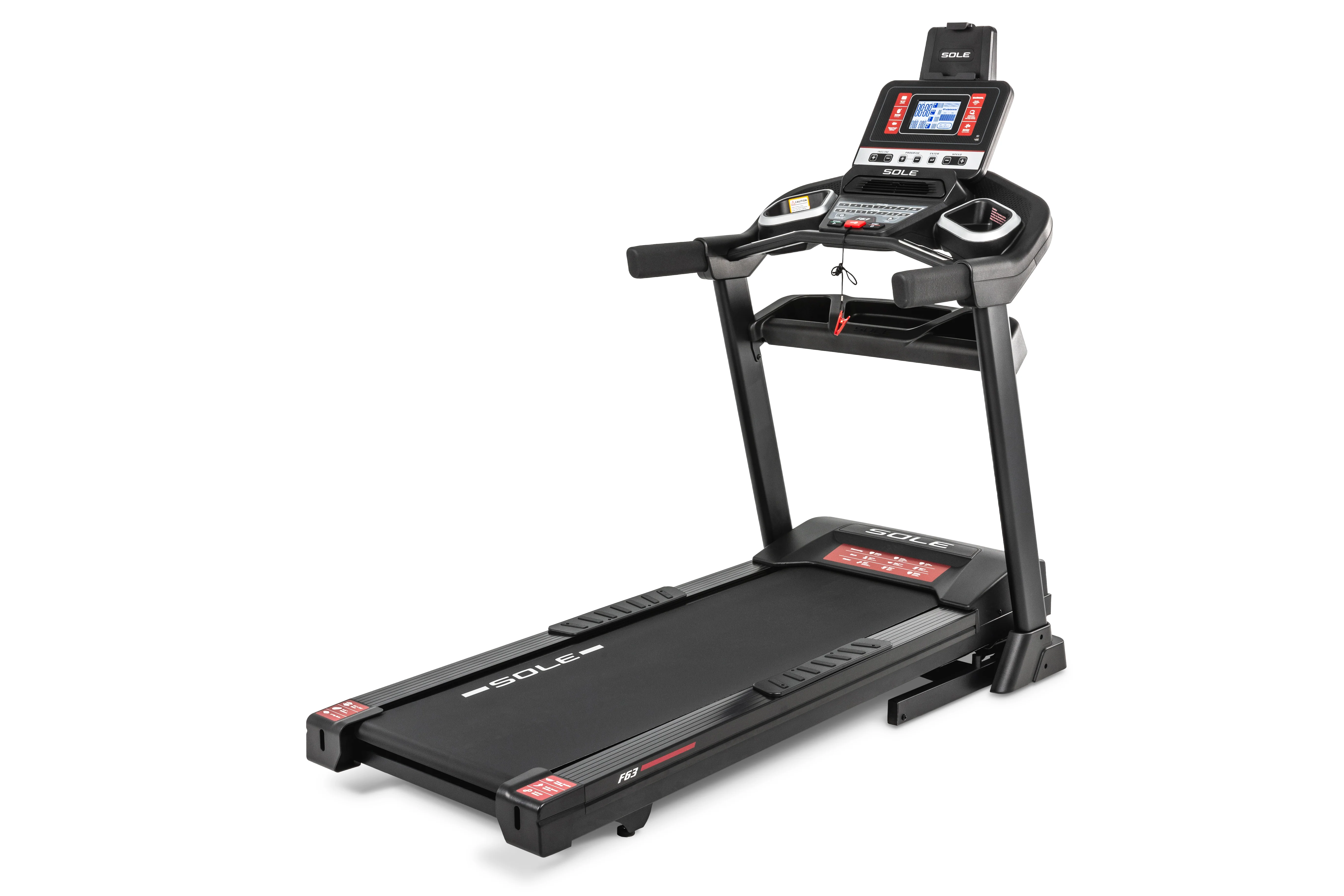
The first mistake is comparing screens before measuring the room. Sole lists the F80 and F85 at 82.5 L x 38 W x 66 H when assembled, with folded dimensions of 45 L x 38 W x 71.5 H. The F63 is also a full-size folding treadmill, and Good Housekeeping lists it at 82 L x 35 W x 66 H, folded to 50 L x 35 W x 72 H. These are not casual corner objects.
Before comparing price, mark the active footprint with tape. Then check the folded footprint, the ceiling height, the clearance behind the deck, the nearest outlet, and the route from curb to room. Sole offers room-of-choice and assembly upgrades on the F63 page, which matters because these machines are heavy. If the treadmill has to move upstairs or through a narrow hallway, setup logistics should be part of the buying decision, not an afterthought.
The education and home-office angle is practical rather than academic. A treadmill near a desk or study room can support movement breaks during remote work, online classes, or family routines. But if it blocks a walkway or creates friction every time someone folds it down, the routine will fail. Fit starts with whether the machine can stay accessible.
Choose the Sole F63 If You Want Value and Simpler Walking Sessions
The Sole F63 is the model to check first if the treadmill will mostly support walking, incline walking, light jogging, and basic cardio blocks. Sole lists the F63 with a 3.0HP motor, 0.5-12 MPH speed range, 15 incline levels, a 20 x 60 running surface, kick-release folding, Bluetooth speakers, USB Type-A charging, and a 6.5 backlit LCD. Its official page showed a sale price of $999.99 when checked on June 11, 2026, but pricing can change quickly.
Good Housekeeping includes the F63 as a beginner-friendly treadmill in its 2026 treadmill guide and folding treadmill guide, pointing to its sturdy build, spacious belt, 12 mph speed range, 15 incline levels, tablet holder, USB charging, and Bluetooth speakers. SELF also recommends the F63 for walking-focused use in older 2024 coverage, while noting that testers found it could feel shaky at faster running speeds around 9 mph.
That makes the F63 a good fit for a buyer who wants a reliable machine without a large touchscreen or a mandatory content subscription. It is less ideal for a household with multiple runners, a tall runner with a long stride, or someone who expects high-speed sessions several days a week. The 20 x 60 belt is usable for many people, but the F80 and F85 give you a wider 22 x 60 deck.
Choose the Sole F80 If the Treadmill Will Be Shared
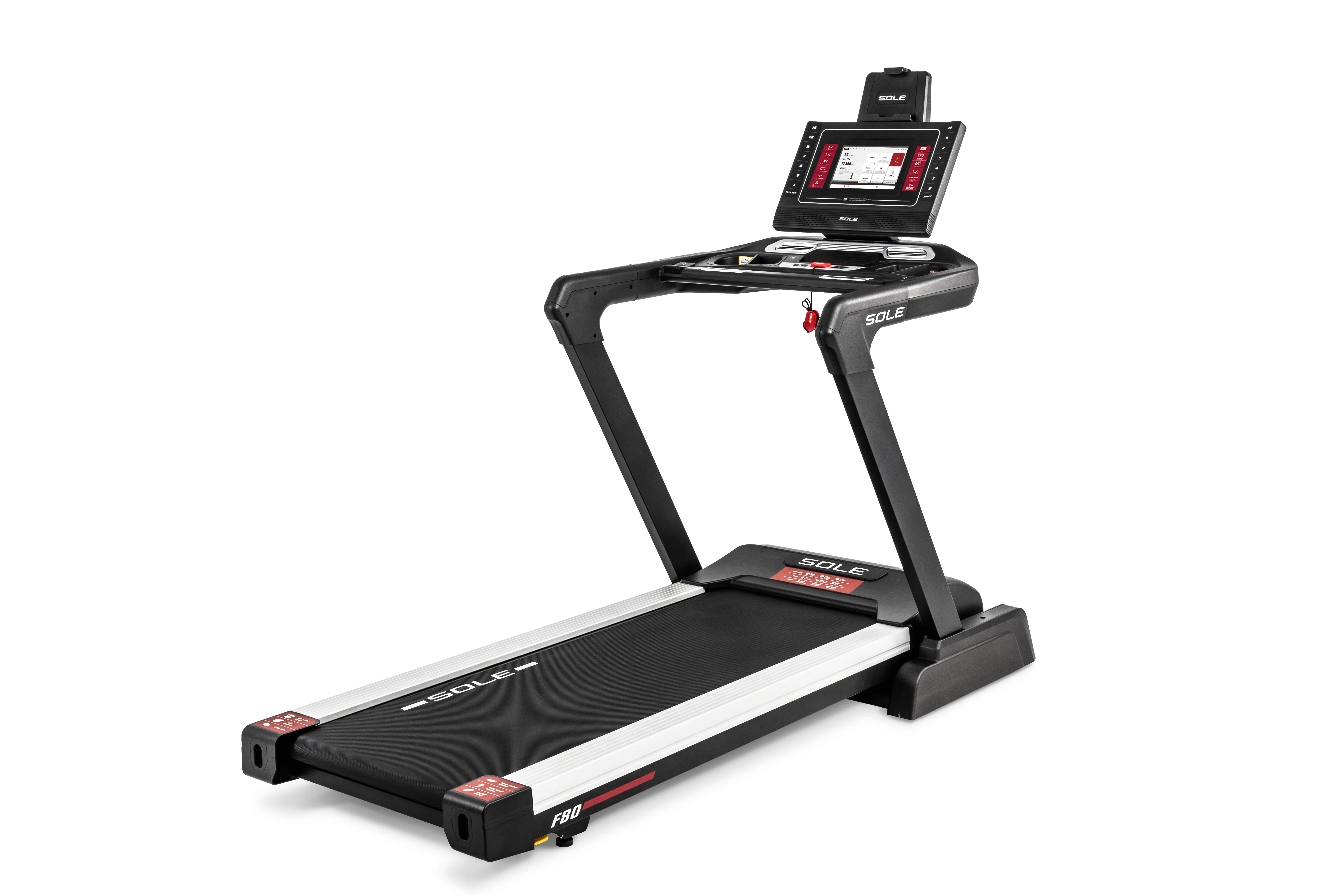
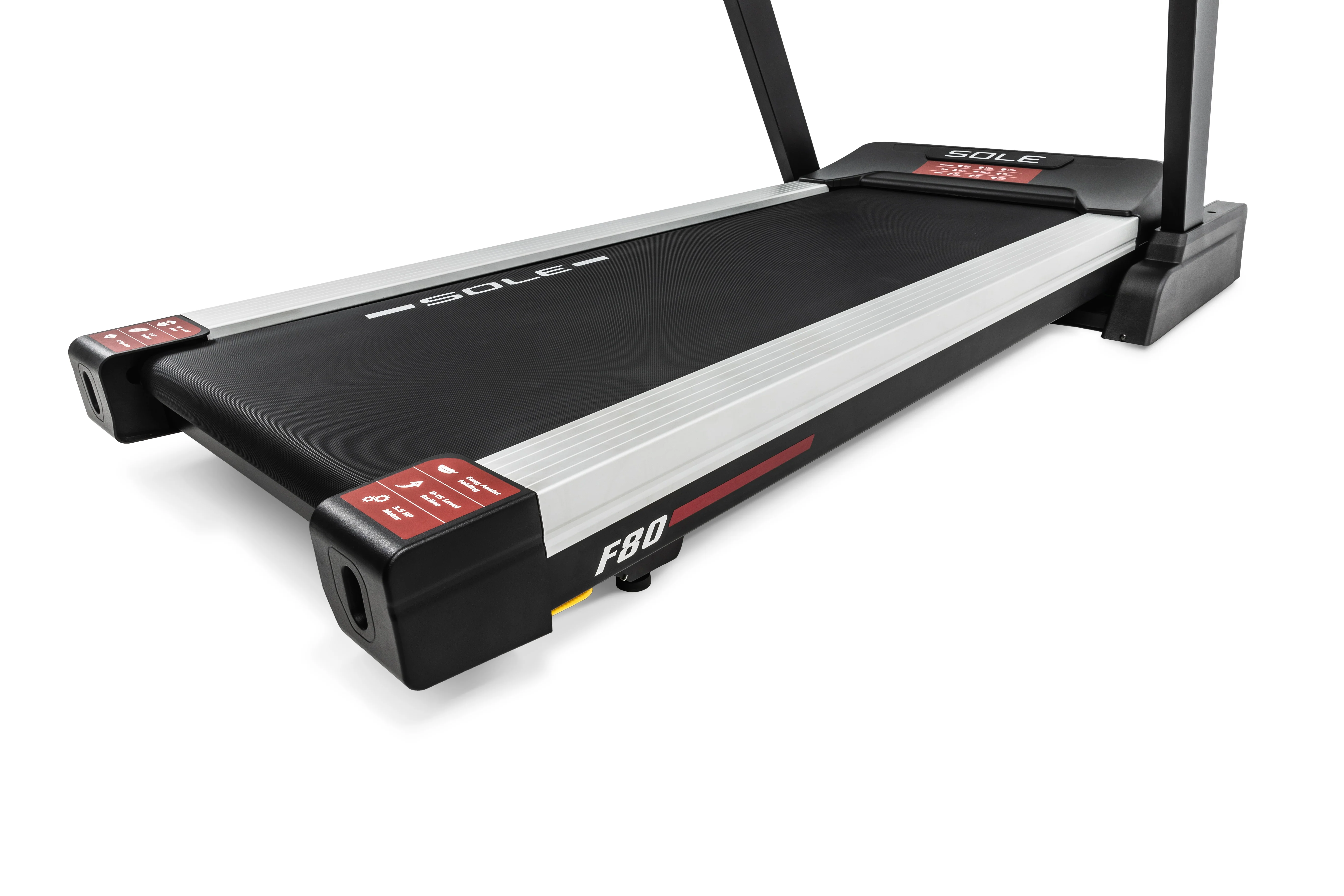
The F80 is the middle model that often makes the most sense for a shared home. Sole lists it with a 3.5 CHP motor, 10.1 touchscreen, 0.5-12 MPH speed range, 15 incline levels, 22 x 60 running surface, 350 lb capacity, wireless charging, Bluetooth speakers, Wi-Fi, preloaded apps, and a release-lever folding mechanism. Warranty information on the official F80 page lists lifetime frame and motor, three years deck, parts, and wear items, one year labor, and 90 days cosmetic items.
The fit difference is the deck. A 22-inch width gives more room for tired strides, larger users, and households where one person walks while another runs. It also reduces the chance that a buyer outgrows the machine after a few months of consistent training. If the treadmill will live in a shared family room or home gym, the F80 is easier to justify than the F63.
The F80 also keeps Sole's hardware-first personality. It adds a modern touchscreen and apps, but it is not built around a required membership. That matters if the household already uses YouTube, Peloton App, Apple Fitness, Zwift, Netflix, or self-directed workouts. You are buying the machine first, not renting access to the core experience every month.
Choose the Sole F85 Only When the Upgrade Solves a Real Problem
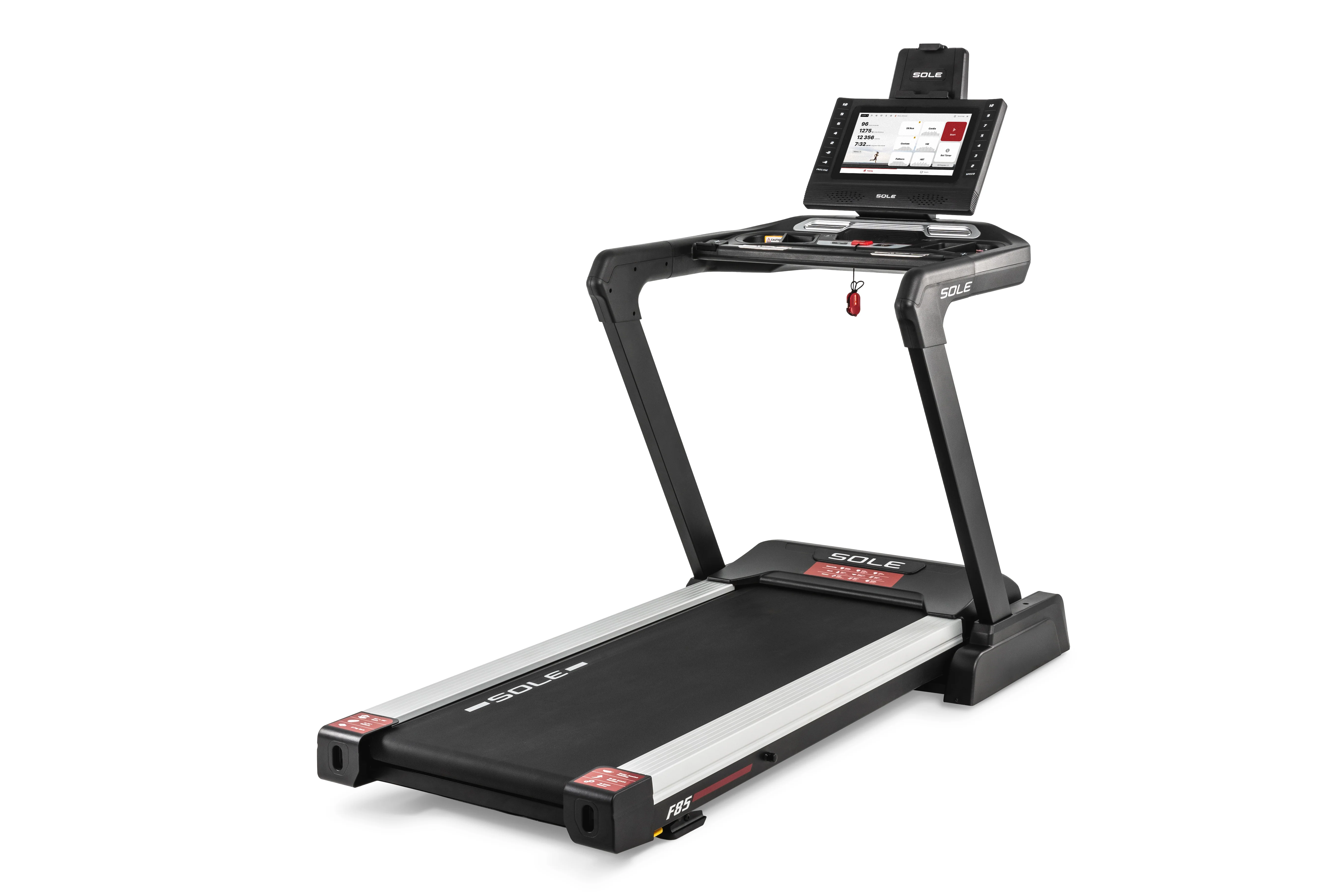
The F85 is the easiest model to overbuy, but it is also the clearest choice for specific users. Sole lists the F85 with a 4.0 CHP motor, 15.6 touchscreen, 0.5-12 MPH speed range, 15 incline levels, 6 decline levels, 22 x 60 running surface, 375 lb capacity, 2.75 rollers, wireless charging, Bluetooth speakers, Wi-Fi, and preloaded apps. It also lists lifetime frame and motor coverage, three years deck, parts, and wear items, one year labor, and 90 days cosmetic items.
The upgrade makes sense when at least one of three things is true. First, the main user is heavier or wants more capacity headroom. Second, the treadmill will be a primary running tool rather than a backup for bad weather. Third, decline training and a larger screen are genuinely useful, not just attractive in a product photo.
SELF's 2024 home treadmill coverage highlights the F85 as a stronger Sole option with a wide 22-inch belt and 4.0 HP motor, while also noting that Sole's simpler F63 can be enough for buyers who do not want complicated tech. That is the right distinction. The F85 should solve a use-case problem. If it only looks more premium, the F80 may be the more disciplined buy.
Compare Fit by Use Case, Not by Spec Sheet Alone
| Use case | Better Sole fit | Why |
|---|---|---|
| Walking during study or work breaks | F63 | Lower price, full-length belt, simple controls |
| One casual walker and one regular runner | F80 | Wider deck and higher capacity than F63 |
| Multiple users with different stride lengths | F80 or F85 | 22 x 60 deck gives more room |
| Heavier user or frequent running | F85 | Higher capacity, stronger motor, larger rollers |
| Buyer wants no required subscription | F63, F80, or F85 | Sole positions the line around subscription-free use |
| Smallest possible footprint | None of these | Consider a true walking pad instead |
The key is to avoid a false bargain. The F63 is cheaper, but it is not automatically the best fit if the treadmill will be shared by two runners. The F85 is stronger, but it is not automatically smarter if the machine will mostly be used for 30-minute walks. The F80 is the middle option because it covers more household situations without jumping all the way to the largest screen and highest capacity.
Common Fit Mistakes Before Buying a Sole Treadmill
The first mistake is ignoring step-up height and ceiling clearance. Sole lists an 8-inch step-up height for the F80 and F85. Taller users need enough ceiling clearance to walk and run comfortably, especially if the treadmill sits in a basement or spare room.
The second mistake is treating folding as the same as compact. Folding helps reclaim floor space, but the folded machine still has height, width, and weight. If you need to move the treadmill after every use, confirm wheel placement, folded dimensions, and whether one person can safely reposition it.
The third mistake is buying a smart screen to solve a motivation problem. A screen can help, but it cannot fix a routine that is inconvenient. If your best workout window is between calls or classes, the machine should be easy to start, pause, and use without setup friction.
The fourth mistake is forgetting medical and household constraints. Sole notes that some equipment with wireless smartphone charging emits magnetic fields that may interfere with implanted medical devices. If that applies to you or someone in your home, check the current product warnings and ask a medical professional before buying.
Internal Reading for Home Study and Setup Decisions
If you are building a home routine around work, school, and family use, pair this guide with our /reviews/sole-treadmills-review-home-routines/ for a broader Sole brand review, /reviews/movavi-screen-recorder-review/ for recording lessons and presentations, /reviews/movavi-academic-review/ for academic video workflows, and /reviews/planner-5d-review/ for planning room layouts before large equipment purchases.
FAQ
Which Sole treadmill is best for a small room?
The F63 is usually the easiest Sole model to justify for a smaller room because it is the value model and has a slightly narrower listed footprint than F80 and F85. Still, it is a full-size folding treadmill, not an under-desk walking pad. Measure both active and folded dimensions before buying.
Is the Sole F80 worth it over the F63?
The F80 is worth considering if you run regularly, share the treadmill, or want a wider 22 x 60 deck. If the machine is mainly for walking and light jogging, the F63 can be enough. The choice depends more on use frequency and household sharing than on screen size.
Who should choose the Sole F85?
Choose the F85 if you need more capacity, a stronger motor, decline training, larger rollers, or a bigger 15.6 touchscreen. It is a serious home treadmill for heavier use. Casual walkers may be better served by the F63 or F80.
Do Sole treadmills require a monthly subscription?
Sole positions its treadmills around subscription-free use. Higher models include apps and Sole+ integration, but the basic treadmill experience does not depend on a mandatory monthly training membership. Always verify current app and feature terms before purchase.
Are Sole treadmills good for running?
They can be, especially the F80 and F85 for regular running. Good Housekeeping treats the F63 as beginner-friendly, while SELF notes that F63 testers found it less ideal at faster paces. If running is the primary use, the wider-deck models are safer choices.
Final Verdict
A Sole treadmill is a fit decision before it is a feature decision. Start with the room, the delivery path, the number of users, and how fast people will actually run. The F63 fits value-focused walking and light running. The F80 fits shared homes and regular runners. The F85 fits heavier use, decline training, and buyers who will benefit from the larger screen. Buy the model that removes friction from the weekly routine, not the one with the longest spec list.
Title Candidates
- Sole Treadmill Fit Guide: F63, F80, or F85 for Your Home
- Which Sole Treadmill Fits Your Room and Routine?
- Sole F63 vs F80 vs F85: A Practical Fit Guide
- Before You Buy a Sole Treadmill, Measure These Things
- The Sole Treadmill Decision Guide for Shared Homes