Affiliate disclosure: This article may contain affiliate links. If you follow a link and make a purchase, the publisher may earn a commission at no extra cost to you.
Amplitude Referral Guide: Platform Fit, Pricing and Alternatives
Who This Amplitude Referral Guide Is For
This guide is for product, growth, data and digital-experience teams deciding whether Amplitude belongs on their analytics shortlist. It is not a claim that one platform will be the best answer for every organisation. The useful question is narrower: does Amplitude’s publicly described scope match the workflows your team needs to support, the data you can maintain, and the controls you need before rollout?
Amplitude presents its platform around understanding digital behaviour and taking action from that understanding. Its public materials describe product analytics, marketing analytics, session replay, heatmaps, experimentation, guides and surveys, activation, data governance, integrations, and security and privacy. That breadth may be relevant if several teams currently use disconnected tools, or if one team needs to evaluate several of these jobs together. [1]
A referral decision should still start with your own operating context. A small product team may be looking for a practical way to understand journeys and test changes. A larger organisation may care more about retention, permissions, data retention, implementation ownership and commercial terms. Neither situation can be resolved from a feature list alone.
Use this guide as an evaluation framework. Treat public platform statements as a starting point, validate the workflows that matter with your own data and users, and confirm current plan terms directly before purchase or implementation.
Shop Amplitude Referral Guide: Platform Fit, Pricing and Alternatives →
What Amplitude Covers
Amplitude publicly groups its offering into a connected set of analytics, action and data capabilities. On its platform page, it describes Product Analytics as a way to understand the full user journey and Marketing Analytics as a way to obtain marketing metrics. It also lists AI Analytics, AI Agents, AI Feedback, Amplitude MCP and Agent Analytics under its AI-focused platform areas. [1]
For behavioural investigation, the public product list includes Session Replay, described as visualising sessions based on product events, plus Heatmaps for visualising clicks, scrolling and engagement. Zoning Insights is also listed as a way to overlay performance and revenue metrics on webpages. These descriptions indicate areas a buyer can assess; they do not establish that every implementation will produce a particular insight or improvement. [1]
Amplitude also lists Guides and Surveys, Feature Experimentation, Web Experimentation and Feature Management. Its public wording links these areas to guiding users, collecting feedback, personalised product experiences, A/B testing and learning while shipping. Activation, Data Governance, Integrations, and Security & Privacy appear alongside those product capabilities, making the public platform scope broader than reporting alone. [1]
The pricing page says every plan includes the full platform and unlimited seats, while also listing plan-specific allowances and entitlements. For example, its Free plan lists limited experiments, guides and surveys, while Plus adds specified capacity and features. A buyer should therefore distinguish between a capability appearing in the platform map and the level of access, volume or administration available on the plan being considered. [2]
Potential Strengths for Product Teams
AI-generated generic editorial illustration — not a retailer product photo and does not depict the reviewed product or service. Frame strengths as evaluation considerations rather than promised outcomes.
 A reason to put Amplitude on a shortlist is the possibility of assessing related product-data workflows in one platform conversation. Its public materials place product and marketing analytics, replay, heatmaps, experimentation, feedback tools, activation and governance in the same overall platform. For a team that otherwise evaluates separate analytics, testing and qualitative-feedback products, that can make the comparison process more coherent. [1]
The strongest potential fit is not “more features” in the abstract. It is a team with a defined chain of questions: understand a journey, inspect relevant sessions or interactions, collect feedback, decide what to change, test a change, and make selected data available across teams. Amplitude’s public descriptions cover components of that chain, including Product Analytics, Session Replay, Heatmaps, Guides and Surveys, Feature Experimentation, Activation and Data Governance. [1]
The AI-related areas may also be worth reviewing where teams are actively deciding how analytics should work with AI tools or agents. Amplitude lists AI Analytics, AI Agents, AI Feedback, Amplitude MCP and Agent Analytics, with Agent Analytics described as measuring the impact of agents. Whether those areas are relevant depends on your existing workflows, governance requirements and practical access on the plan under review. [1][2]
Consolidation can introduce trade-offs as well as convenience. A team should test whether the event model, analysis workflow, replay configuration and experimentation process make sense for its own users and release practices. It should also identify who owns instrumentation, who can create or change projects, and how product, engineering, marketing and data teams will work in the same environment. The supplied public evidence describes the platform’s stated scope, not the effort or outcome of a particular implementation.
A sensible evaluation workshop can therefore score three things separately: the importance of each workflow, the team’s readiness to support it, and the plan-level access required. This avoids mistaking a public capability list for proof of fit.
Pricing and Scale Considerations
AI-generated generic editorial illustration — not a retailer product photo and does not depict the reviewed product or service. Help readers interpret plan progression and scale questions.
 Amplitude’s pricing page presents Free as an entry point for individuals and explorers getting started. It states that the Free plan includes 2M events per month forever and requires no credit card. The listed Free entitlements include Basic Product Analytics, one-time cohort syncs, 2,000 AI feedback records, 10K monthly session replays, limited Experiments, Guides & Surveys, and 500 active AI Visibility prompts. [2]
Plus is presented for small teams finding product-market fit. The page says it starts at $0, requires a credit card, and includes the first 2M events per month free. It then lists the ability to scale up to 70M events, custom events and formulas, 20 behavioural cohorts, alerts, heatmaps, 1,000 active AI Visibility prompts and two-year data retention. [2]
Growth is described as being for businesses looking to scale and as using custom event-based pricing. The supplied pricing evidence lists items such as Advanced Behavioral Exploration, currency conversion, monitoring and alerts, 20K monthly session replays, 2,500 active AI Visibility prompts, SSO and Project Permissions under Growth. Enterprise is presented for larger enterprises with complex requirements and is also described as custom event-based pricing in the supplied excerpt. [2]
These published details are useful for forming questions, not for estimating your bill from this guide. Start with expected events, then separately check replay volume, retention, cohort needs, experiment and survey requirements, identity or project controls, and commercial terms. Confirm how your projected usage is measured and what happens when it changes.
Before treating Free or Plus as a lasting fit, run a realistic instrumentation and usage forecast. Before treating Growth or Enterprise as a fit, request current commercial details and validate the exact governance and permissions requirements with Amplitude. Plan names and public allowances can change, so the pricing page and a direct conversation should be the final source for a buying decision.
Limitations and Due-Diligence Checks
AI-generated generic editorial illustration — not a retailer product photo and does not depict the reviewed product or service. Make balanced due-diligence checks easy to scan.
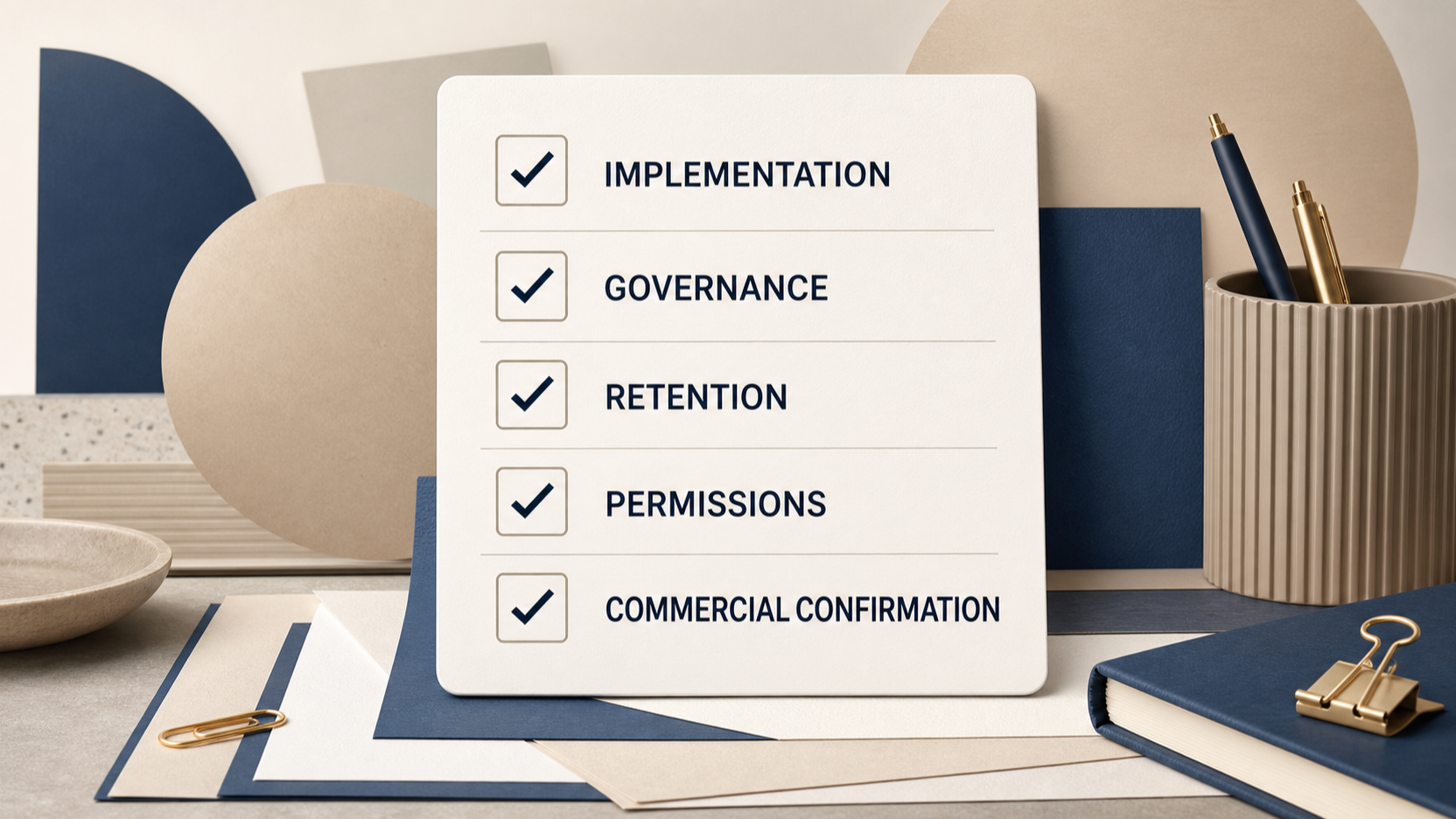 The public evidence supports a description of Amplitude’s stated capabilities and selected pricing terms. It does not prove implementation speed, data quality, adoption, experiment velocity, return on investment or suitability for a particular company. Those outcomes depend on decisions that cannot be established from a public platform page: what events are captured, how identities are handled, who governs definitions, and how teams act on the analysis.
Plan access is one important limitation to test. The pricing page states that every plan includes the full platform and unlimited seats, but it also specifies different limits or entitlements across Free, Plus and Growth. For example, Free lists 10K monthly session replays and limited Experiments, Guides & Surveys, while Plus lists two-year data retention and other expanded capabilities. Check the exact entitlement associated with every workflow you expect to use. [2]
Implementation is another due-diligence area. Ask your team to test a small but representative journey: define the events, verify that the captured data answers a real product question, inspect access patterns, and identify where ownership or data-definition decisions are required. A successful demonstration should include the people who will instrument, analyse, interpret and govern the data—not only the eventual buyer.
Review permissions and governance explicitly. Amplitude publicly lists Data Governance, Security & Privacy, and, on Growth, SSO and Project Permissions. Those public labels do not answer your organisation’s security review by themselves. Confirm the current controls, retention treatment, project structure, user roles and any required compliance documentation directly. [1][2]
Finally, keep commercial validation separate from product validation. A workflow can be appealing while a specific allowance, retention term or contract model is unsuitable. Record unresolved questions, assign owners, and do not convert an assumption into a rollout commitment.
How to Compare Amplitude with Alternatives
A useful alternatives review starts with requirements rather than a generic ranking. Create a short scorecard and give each category a clear definition: analytics depth, journey analysis, session replay, heatmaps, experimentation, feedback collection, activation, governance, integrations, permissions, retention and budget model. Then identify which categories are essential, useful or out of scope for your team.
Amplitude’s public platform map provides one side of that scorecard. It lists Product Analytics, Marketing Analytics, Session Replay, Heatmaps, Guides and Surveys, Feature Experimentation, Web Experimentation, Feature Management, Activation, Data Governance, Integrations, and Security & Privacy. Use that list to form demonstrations and questions, not to assume equal depth or availability across every plan. [1][2]
Compare each candidate against the same scenario. For example: can the team represent a key user journey with its event model? Can a product manager investigate a question without changing the underlying meaning of the data? Can the team review relevant sessions or interactions? Can it run the desired testing workflow? Can it control access and sustain the required retention period? Can the expected usage fit the commercial model?
Avoid naming a winner based on a feature count. A platform with a smaller apparent scope may be a better operational fit if it matches the team’s data maturity, ownership model and budget. Conversely, a broader platform may be attractive when connected analytics, experimentation, feedback, activation and governance are genuine requirements rather than future possibilities.
Use a time-boxed proof of fit where possible. Keep the test narrow, document what was configured, ask each participating role for evidence-based feedback, and compare the remaining gaps against the requirements scorecard. This produces a decision record that can survive beyond a sales demonstration.
Shop Amplitude Referral Guide: Platform Fit, Pricing and Alternatives →
A Practical Selection Path
Start by writing the decision in one sentence: what customer, product or business question must the analytics platform help the team answer? Then map the workflows needed to support that decision. Include only the capabilities that matter now, such as product analytics, replay, experimentation, feedback, activation or governance.
Next, identify the data work required for a credible evaluation. Choose a representative journey, define the events and properties needed to understand it, and agree who is responsible for data definitions. Test whether the resulting analysis is understandable to the people who will use it. Do not treat a polished demo using sample data as proof that your production instrumentation is ready.
Then validate plan constraints. Compare expected event volume, replay needs, retention, cohort use, experiments, guides, surveys, permissions and SSO requirements against the current pricing information. Amplitude’s public pricing page lists Free and Plus entry points and says Growth and Enterprise use custom event-based pricing; confirm the current details directly before making a commercial commitment. [2]
Finally, conduct a practical governance and commercial review. Confirm access patterns, project permissions, data governance and security requirements, then request the current terms that apply to your situation. End with a written go, no-go or deferred decision and a list of open questions. The primary CTA should direct readers to check current Amplitude plan details before they buy or begin rollout.
Amplitude Referral Guide FAQ
What does Amplitude publicly list as part of its platform?
Amplitude publicly lists AI-focused capabilities, Product Analytics, Marketing Analytics, Session Replay, Heatmaps, Zoning Insights, Guides and Surveys, experimentation, Feature Management, Activation, Data Governance, Integrations, and Security & Privacy. [1]
Does Amplitude offer a free plan?
Yes. Its pricing page lists a Free plan with 2M events per month forever and no credit card required. [2]
What limits should a team review on the Free and Plus plans?
Review events, session replays, AI feedback records, prompts, experiments, guides, surveys, cohorts, retention and any workflow-specific entitlement. The public page lists 10K monthly session replays on Free, while Plus lists scale up to 70M events and two-year data retention, among other differences. [2]
Are experimentation and session replay included in Amplitude’s public platform description?
Yes. The platform page lists Session Replay, Feature Experimentation and Web Experimentation; the pricing page also lists Session Replay and Experimentation among the platform areas. [1][2]
What should I confirm directly with Amplitude before choosing a plan?
Confirm current usage measurement, applicable allowances, retention, replay volume, experiment and survey access, permissions, SSO or project requirements, governance and security documentation, and commercial terms. Public pages describe the starting point; your implementation and contract need direct confirmation.
Sources
[1] Amplitude public platform description.
[2] Amplitude public pricing page.
Sources
Editorial information: About our editorial team · Read our editorial policy · Read our affiliate disclosure.
Shop Amplitude Referral Guide: Platform Fit, Pricing and Alternatives →