This review is based on current LinkedIn Learning platform data, published pricing and feature information, third-party reviews from Capterra, Class Central, and learning platform comparison sites, and direct comparison with competing platforms. AspectsInspire does not fabricate first-hand testing claims. Where we reference course quality or platform behavior, we cite publicly available evidence. For more about our review methodology, see our editorial policy and about page.
What LinkedIn Learning actually offers — and what it does not
LinkedIn Learning is a subscription-based professional development platform offering 25,300+ courses across business, technology, and creative categories. It evolved from Lynda.com — which LinkedIn acquired in 2015 for $1.5 billion — and its core value proposition is unique among learning platforms: courses are tied directly to your LinkedIn professional profile.

Complete a course on project management, and a certificate badge appears on your LinkedIn profile where recruiters and hiring managers can see it. This integration is not just cosmetic — LinkedIn's algorithm uses your learning activity to inform job recommendations and skill endorsements. 78% of Fortune 100 companies use the platform for employee training, which tells you where the real revenue comes from: enterprise, not individual learners.
What LinkedIn Learning is not is an academic platform. There are no university partnerships, no accredited degrees, no capstone projects graded by professors. If you need a credential that carries formal academic weight — a professional certificate from Google, a MasterTrack from a top university — Coursera is the correct choice. LinkedIn Learning's certificates indicate "this person completed this course," not "this person passed a rigorous assessment by an accredited institution."
The platform is also not a marketplace. Unlike Udemy, where anyone can upload a course and quality varies wildly, LinkedIn Learning vets its instructors and maintains consistent production standards. This curation means a smaller catalog (25,000 vs. Udemy's 210,000+) but more reliable baseline quality.
Pricing breakdown: what you actually pay
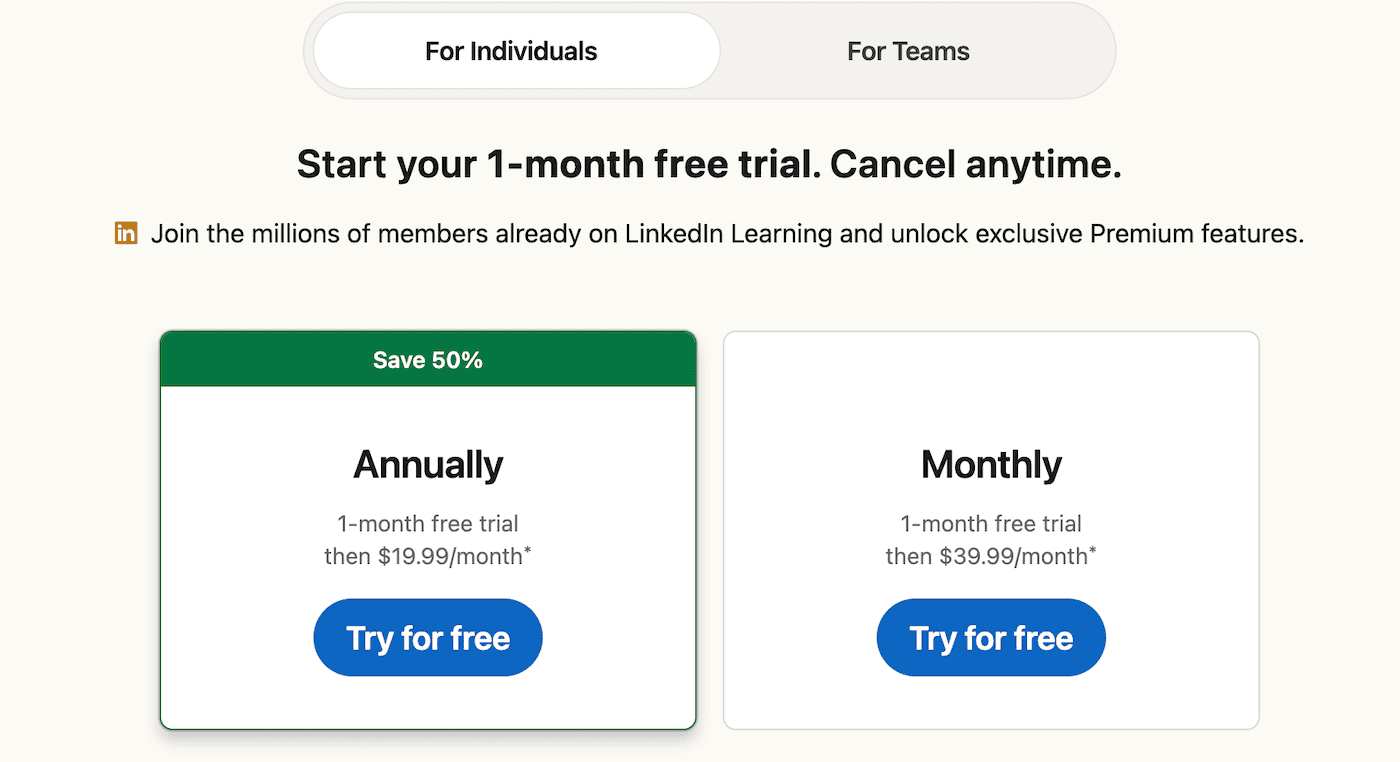
LinkedIn Learning's pricing has an important twist: it is bundled with LinkedIn Premium. This means many professionals already have access without realizing it.
| Plan | Cost | Per-month equivalent | Includes Premium | Free trial |
|---|---|---|---|---|
| Learning (Monthly) | $39.99/month | $39.99/month | Yes (Career tier) | 1 month |
| Learning (Annual) | $239.88/year | ~$19.99/month | Yes (Career tier) | 1 month |
| Premium Career | $29.99/month | $29.99/month | Yes (full access) | 1 month |
| Premium Business | $59.99/month | $59.99/month | Yes (full access) | 1 month |
| Teams (2-20 users) | $379.99/seat/year | ~$31.66/seat/month | Admin dashboard | Custom |
| Individual courses | $20-$50 each | One-time | No | N/A |
The pricing creates an interesting dynamic. If you already pay for LinkedIn Premium Career at $29.99/month for job searching features (InMail, salary insights, applicant visibility), you already have full LinkedIn Learning access — at a lower price than the standalone Learning subscription at $39.99/month. Check your current LinkedIn subscription before paying separately.
The 1-month free trial gives full access to the entire library. A credit card is required, but you can cancel at least one day before the trial ends without being charged. No refunds are available after billing, except for EU residents who have a 14-day window. For deal timing across platforms, our course deals seasonal guide covers when prices drop.
About 5,000 courses are also available for individual purchase at $20-$50 each, with lifetime access but no Premium features. LinkedIn plans to expand this to the full library, which could change the platform's value equation for occasional learners.
The course library: corporate-strong, creative-adequate
LinkedIn Learning's 25,300 courses are taught by 3,900+ vetted experts and organized into three main pillars: Business, Technology, and Creative. The distribution tells you who the platform is really built for.

Where LinkedIn Learning excels
Business and leadership — This is the platform's strongest territory. Courses on project management, strategic thinking, executive communication, people management, and organizational leadership are taught by recognized practitioners and authors. The content aligns directly with skills that hiring managers search for on LinkedIn, creating a feedback loop between learning and career visibility.
Software and productivity tools — Training on Microsoft 365, Google Workspace, Salesforce, Tableau, and other enterprise tools is consistently polished and up-to-date. LinkedIn Learning holds professional certificates from Microsoft that prepare learners for official Microsoft certifications — one of the platform's strongest differentiators against generalist competitors.
Career development — Resume writing, interview preparation, salary negotiation, and personal branding courses are uniquely valuable here because they connect directly to your LinkedIn profile. A course on "Optimizing Your LinkedIn Profile" taught on the platform that owns LinkedIn carries a different weight than the same topic on Udemy.
IT and cloud fundamentals — With 2,000+ courses preparing learners for 120+ off-platform credentials (AWS, CompTIA, PMP, ITIL, and others), the platform serves as effective study support for certification exams. The courses themselves are not certifications, but they map to exam objectives and include practice assessments.
Where LinkedIn Learning is thinner
Deep technical programming — While the platform covers Python, JavaScript, and web development fundamentals, it lacks the depth of Pluralsight for advanced engineering topics or the breadth of Udemy for niche technical skills. Virtual coding environments via GitHub Codespaces are available but limited in scope compared to dedicated code-learning platforms like Codecademy.
Creative and design — LinkedIn Learning covers Adobe Creative Suite, UX design, and photography, but the catalog is significantly thinner than Skillshare's 30,000+ creative classes. If your primary goal is illustration, motion graphics, or applied creative skills, Skillshare's project-based model and specialist instructors offer more value.
Academic and research-oriented content — No university partnerships, no peer-reviewed course design, no guided capstone projects. The platform's courses are practical and workplace-oriented, not academic. This is a feature for corporate learners and a limitation for career changers who need credential depth.
The LinkedIn integration: the real differentiator
Every other learning platform gives you a PDF certificate. LinkedIn Learning gives you a certificate that lives inside the professional network where 1 billion+ members and millions of recruiters operate. This distinction deserves its own section.
How the integration works
When you complete a course, the certificate automatically appears in the "Licenses & Certifications" section of your LinkedIn profile. Skills tagged to that course get added to your "Skills" section. LinkedIn's algorithm then:
- Surfaces your profile to recruiters searching for those skills
- Recommends jobs that match your newly validated skill set
- Updates your skill endorsements with verified learning activity
- Shows learning activity in your feed, signaling professional development to your network
This is not a minor feature. In a 2026 hiring landscape where recruiters routinely filter candidates by skills on LinkedIn, having visible, verifiable learning activity attached to your profile creates a tangible advantage over candidates who learned the same skills on Udemy but have no visible proof.
The limitation
LinkedIn Learning certificates are not accredited. They reflect completion, not competency assessment by a third party. A hiring manager may see your project management certificate and think "this person invested time in learning" — but it does not substitute for a PMP, CAPM, or university credential when formal requirements exist. For roles where specific certifications are legally or contractually required, you still need the official exam. LinkedIn Learning can prepare you for it; it cannot replace it.
Learning paths and AI-powered recommendations
LinkedIn Learning offers 1,300+ curated learning paths — structured sequences of 5-15 courses that build toward a specific role or skill goal. Examples include "Become a Data Analyst," "Prepare for the PMP Exam," and "Build Your Leadership Skills."
Role guides
A newer feature, Role Guides, covers over 35 different roles and maps the courses, learning paths, and skills needed for each. If you tell LinkedIn Learning you want to become a UX designer, it builds a personalized curriculum from the existing library. This is more prescriptive than Coursera's specializations but less rigorous — no graded assignments, no peer reviews, no capstone.
AI coaching
The platform's AI-powered coaching feature provides personalized learning recommendations based on your LinkedIn profile, job title, career goals, and learning history. It answers questions about career development and suggests specific courses. Early reviews suggest it is useful for discovery but not yet a replacement for structured mentorship.
Assessment tools
With 300,000+ quiz questions embedded across the library, LinkedIn Learning provides knowledge checks throughout courses. LinkedIn Skill Assessments — separate from course quizzes — let you earn a "Verified" badge on specific skills (Excel, Python, AWS, etc.) that appears on your profile. These assessments are timed, multiple-choice tests that roughly 1 in 4 test-takers pass, adding a layer of credibility above basic course completion.
Who LinkedIn Learning is actually for
Based on the platform's strengths and limitations, here is an honest fit assessment.
LinkedIn Learning works well for:
- Corporate professionals who need to upskill in business, leadership, or enterprise software without leaving their workflow — the LinkedIn integration keeps learning and career management in one place
- Job seekers already paying for LinkedIn Premium Career — you have full access included, and visible learning activity strengthens your candidate profile
- Team leads and L&D managers building a training library for 2-20 person teams at $379.99/seat/year, with admin dashboards and progress tracking
- Certification preppers studying for Microsoft, AWS, PMP, or CompTIA exams — the platform's 2,000+ prep courses map to exam objectives and cost nothing beyond the subscription
- Professionals maintaining skills who want 30-90 minute refreshers on tools, frameworks, or soft skills they use daily
LinkedIn Learning is the wrong choice for:
- Career changers who need accredited credentials — Coursera's professional certificates from Google, IBM, and Meta carry formal recognition that LinkedIn Learning certificates cannot match
- Deep technical learners who need comprehensive, multi-month programming or data science curricula — Coursera, Udemy, or specialized platforms like Pluralsight serve this better
- Creative professionals whose primary goals are illustration, design, photography, or video — Skillshare offers deeper creative content with a project-based learning model
- Budget-conscious learners who need only one or two specific courses — individual Udemy purchases at $10-$20 during sales beat a $240/year subscription for occasional use
- Students without professional experience who are building foundational knowledge — university-partnered platforms offer more structured, graded learning experiences
How LinkedIn Learning compares to alternatives
| Feature | LinkedIn Learning | Coursera | Udemy | Skillshare |
|---|---|---|---|---|
| Model | Subscription | Subscription + per-course | Per-course | Subscription |
| Price | $239.88/year | $59/month (Plus) | $10-$200/course | $167.88/year |
| Catalog | 25,300+ courses | 7,000+ courses | 210,000+ courses | 30,000+ classes |
| Business/leadership | Excellent | Good | Variable | Limited |
| Technical depth | Good | Excellent | Excellent | Thin |
| Creative | Adequate | Limited | Good | Excellent |
| Certificates | Profile-linked (not accredited) | University-backed | Non-accredited | None |
| Best for | Corporate upskilling | Career credentials | One-off skills | Creative projects |
vs. Coursera — Coursera wins on credential depth: university-backed certificates, professional programs from Google and IBM, and accredited online degrees. LinkedIn Learning wins on convenience: shorter courses, tighter LinkedIn profile integration, and broader business/leadership content. If you need a credential to change careers, choose Coursera. If you need to close a skill gap at your current job, LinkedIn Learning is faster and more practical. Our Coursera deep dive covers the credential side in full.
vs. Udemy — Udemy's open marketplace gives you 8x the catalog at lower per-course prices during frequent sales ($10-$15 per course). LinkedIn Learning's curated library offers more consistent quality and the profile integration that Udemy cannot match. For technical deep-dives, Udemy's best instructors rival LinkedIn Learning's. For professional development with career visibility, LinkedIn Learning has the edge. Our Udemy deep dive covers the marketplace model.
vs. Skillshare — These platforms barely overlap. Skillshare dominates creative skills — illustration, photography, design — with its project-based model. LinkedIn Learning dominates professional skills — management, enterprise software, career development. If you need both, you would subscribe to both. Our Skillshare deep dive covers the creative side.
The bottom line on value
LinkedIn Learning's value equation depends on one question: are you already embedded in the LinkedIn ecosystem?
If you use LinkedIn for job searching, networking, or professional visibility — and especially if you already pay for LinkedIn Premium — the learning platform is an easy add. At $239.88/year, you need to complete roughly 3-4 courses per month to bring your per-course cost below $5, competitive with Udemy sale prices. The LinkedIn Premium Career features bundled in ($29.99/month value) effectively subsidize the learning content.
If you do not use LinkedIn actively, the value proposition weakens. The courses are solid but not exceptional enough to justify the price without the profile integration. A Coursera Plus subscription at $59/month gives you deeper, accredited content. Udemy's individual courses cost less for occasional learners. Skillshare offers more creative depth at a lower annual price.
The smart move: take the 1-month free trial, complete as many relevant courses as possible, note which certificates appear on your profile, and assess whether the integration drives visible career benefits. If recruiters start viewing your profile more or your job recommendations improve noticeably, the annual plan is justified. If not, the individual course purchase option at $20-$50 per course may be the more honest path.
For a framework on choosing between all the major platforms based on your specific learning goals and budget, our online course buying guide walks through the decision tree.
Sources: LinkedIn Learning official site, UpSkillWise pricing analysis, Class Central catalog data, Capterra software review. Pricing verified as of April 2026.