This review is based on publicly available platform data, published pricing as of April 2026, and aggregated learner reviews from G2, Gartner Peer Insights, and multiple technology education publications. We did not complete every course discussed — where we reference course counts, assessment data, or lab specifications, we cite Pluralsight's published documentation and third-party review aggregators.
What Pluralsight actually is

Pluralsight is an online learning platform built specifically for technology professionals. Founded in 2004 and operating today as a dedicated skills development service, it hosts 6,500+ curated courses across cloud computing, artificial intelligence, data engineering, IT operations, cybersecurity, and software development — with no creative arts, language learning, or academic credentials anywhere on the platform.
That narrowness is a deliberate choice, and it shapes everything about how Pluralsight works. Unlike Udemy, which is an open marketplace where anyone can publish courses on any topic, Pluralsight curates its catalog. Every course is created by a vetted technical expert, reviewed for quality, and organized into structured learning paths. You will not find 250,000 courses here. You will find 6,500 courses worth taking.
As of January 2026, Pluralsight completed the integration of A Cloud Guru into its Skills platform — one of the most respected cloud training providers in the industry. That integration substantially expands the cloud-specific catalog and brings A Cloud Guru's AWS, Azure, and GCP labs directly into Pluralsight's Cloud+ plan.
The platform reports that 70% of Fortune 500 companies use Pluralsight for team skill development. On G2, it holds approximately a 4.6/5 rating from over 1,000 verified reviews, with consistent praise for the Skill IQ assessments and hands-on labs that distinguish it from video-only competitors.
Who Pluralsight is built for
Pluralsight works best for three groups:
Working technology professionals who need to advance within their current role — a software engineer adding cloud skills, a sysadmin moving into DevOps, a developer picking up security fundamentals. The structured learning paths and Skill IQ assessments make progression measurable rather than vague.
Certification candidates preparing for AWS, Azure, GCP, CompTIA, or other vendor exams. Pluralsight's certification prep sections include mock exams, practice labs, and guided paths built around specific exam objectives.
Teams and organizations investing in structured technical upskilling. The business plans add team dashboards, progress tracking, and admin tools that individual platforms like Udemy lack.
Who should look elsewhere
Creative learners and career changers needing credentials. Pluralsight has no courses in design, illustration, video production, or non-technical business skills. Skillshare is better for creative exploration; Coursera is stronger for university-backed credentials that hiring managers recognize outside of tech.
Budget-first learners who need only one or two courses. Individual courses on Udemy routinely drop to $12–$15 during sales with lifetime access. Pluralsight is subscription-only — there is no single-course purchase option. If you need one specific course, Udemy or the free auditing on Coursera may be more economical.
Non-technical learners. Pluralsight's catalog is narrow by design. If your goals extend beyond tech, you will exhaust its relevance quickly.
Pricing: plans and what you actually get
Pluralsight replaced its previous Standard/Premium structure in early 2026 with a modular plan system. All individual plans include a 10-day free trial with full access.
| Plan | Monthly | Annual | Included content |
|---|---|---|---|
| Core Tech | $30/mo | $252/yr ($21/mo) | 3,900 foundational tech courses |
| AI+ | $35/mo | $294/yr ($24.50/mo) | Core Tech + AI/ML deep catalog |
| Cloud+ | $35/mo | $294/yr ($24.50/mo) | Core Tech + A Cloud Guru full catalog |
| Data+ | $35/mo | $294/yr ($24.50/mo) | Core Tech + 1,400+ data science courses |
| Security+ | $35/mo | $294/yr ($24.50/mo) | Core Tech + cybersecurity content |
| Complete | $55/mo | $468/yr ($39/mo) | All 6,500+ courses across every domain |
The practical decision: if your work is primarily in one domain (cloud architecture, data engineering, application security), the corresponding specialty plan at $294/year gives you the depth you need at a 37% discount versus the Complete plan. If your work spans multiple domains — or if you are building toward a leadership role that requires breadth — Complete at $468/year is worth the difference.
Annual billing saves roughly 30% compared to monthly. For a one-year commitment, the Core Tech annual plan at $252 costs less than nine monthly payments.
Skill IQ: the feature that separates Pluralsight from the competition
The most important reason to choose Pluralsight over a cheaper alternative is not the course catalog — it's the assessment infrastructure.
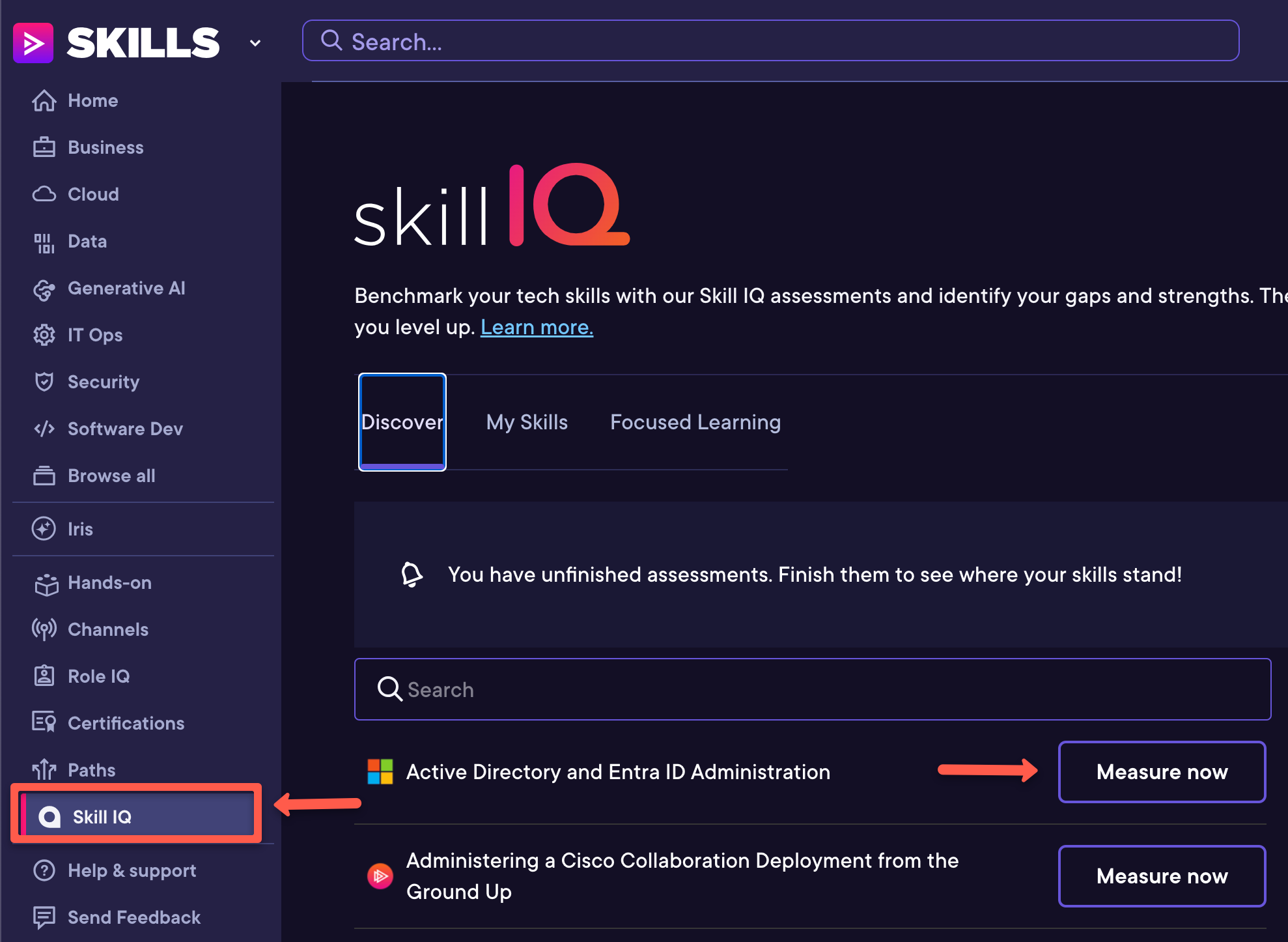
Skill IQ is a 20-question adaptive assessment that measures your proficiency in a specific technology. The questions adjust in difficulty based on your responses, placing you on a Novice-to-Expert scale with a percentile ranking against other Pluralsight learners in that skill area.
The practical value: instead of guessing which courses you need, you take a Skill IQ assessment and get data. A developer who "knows Python" might score Expert on syntax and data structures but Novice on async programming and concurrency. Pluralsight then surfaces the specific learning paths that address those gaps — rather than having you sit through fundamentals you already know.
Pluralsight offers 500+ Skill IQ assessments covering languages (Python, Java, Go, TypeScript), frameworks (React, Django, Spring), cloud platforms (AWS, Azure, GCP), tools (Kubernetes, Terraform, Docker), and security domains.
Role IQ extends this to job-level readiness. Instead of assessing a single skill, Role IQ evaluates whether you are prepared for a specific job role — AWS Solutions Architect, Data Engineer, DevSecOps Engineer — by testing across the full set of competencies that role requires. The result tells you which skills are holding back your readiness and which paths close the gap fastest.
Neither of these tools exists in any meaningful form on Udemy, Skillshare, or LinkedIn Learning.
Hands-on labs and cloud sandboxes
Video courses explain concepts. Labs make them stick.

Pluralsight's lab library includes 3,500+ real-world scenarios with browser-based environments — no local installation, no configuration overhead, no cloud account charges. You open a lab, get a pre-configured environment with the right tools already running, and complete a task in a live system.
The scope is broad:
- Software development labs: debugging exercises, code reviews, architecture challenges
- DevOps labs: Docker containerization, Kubernetes deployments, CI/CD pipeline configuration
- Cloud labs: AWS, Azure, and GCP service configuration with realistic scenarios
- Security labs: penetration testing scenarios, network analysis, vulnerability assessment
The Hands-On Playground goes further: it provisions temporary AWS, GCP, or Azure sandbox accounts — real cloud accounts with actual compute and storage — that expire after the session ends. A developer learning EC2 auto-scaling or a cloud engineer testing GCP networking policies can work in a real environment without setting up billing, creating accounts, or risking unexpected charges.
Labs are available on higher-tier plans. Core Tech subscribers get access to a limited lab library; specialty and Complete plans unlock the full 3,500+ catalog.
Course quality and catalog depth
Pluralsight's curation model produces more consistent quality than an open marketplace, but it also means the catalog is smaller than Udemy's by a factor of 40. The comparison is intentional — these platforms have different philosophies.
What Pluralsight does well:
- Software development: comprehensive coverage of major languages (Python, Java, C#, Go, JavaScript, Rust), frameworks, architecture patterns, and testing methodologies
- Cloud: exceptional depth for AWS, Azure, and GCP, amplified by the A Cloud Guru integration in 2026
- DevOps and platform engineering: Kubernetes, Terraform, Ansible, CI/CD pipelines, and observability stacks
- Security: from foundational CompTIA-level content to advanced threat analysis and penetration testing
Where the catalog shows limits:
- Cutting-edge releases: new frameworks and tools take longer to appear than on Udemy's open marketplace, where instructors can publish within weeks of a release
- Niche topics: obscure languages, specialized frameworks, or non-mainstream tools may have limited or no coverage
- Non-technical skills: management, communication, and career development content exists but is thin compared to platforms built for business professionals
Certification preparation
For developers and IT professionals working toward vendor certifications, Pluralsight's certification prep content is a meaningful differentiator.
The platform provides dedicated paths for major certifications: AWS Certified Solutions Architect, Associate and Professional; Azure Administrator; GCP Professional Cloud Architect; CompTIA Security+, Network+, and CySA+; Certified Kubernetes Administrator (CKA); and dozens more. Each path includes course sequences aligned to the exam objectives, plus practice exams that simulate the actual test format.
The A Cloud Guru integration in January 2026 strengthened cloud certification prep significantly — A Cloud Guru built its reputation specifically on AWS, Azure, and GCP certification training, and that specialized catalog is now accessible through Pluralsight's Cloud+ plan.
Iris: the AI learning assistant
Pluralsight added Iris, an AI-powered learning companion, to help learners navigate the platform and get real-time guidance during their studies. Iris can answer questions about course content, suggest related resources, and help learners understand where to go next in a learning path.
This is a practical addition rather than a showpiece feature — the more important AI integration on Pluralsight is in its assessment and recommendation engine, which connects Skill IQ results to specific learning paths automatically.
Pluralsight vs. alternatives
| Feature | Pluralsight Complete | Udemy Personal Plan | LinkedIn Learning | Coursera Plus |
|---|---|---|---|---|
| Annual price | $468 | $156 | $239 | $399 |
| Course catalog | 6,500+ (tech-only) | 12,000+ (curated subset) | 22,000+ (general) | 7,000+ (university) |
| Skill assessments | Skill IQ + Role IQ | None | Basic skill quiz | None |
| Hands-on labs | 3,500+ with sandboxes | None | Limited | Limited |
| Accredited credentials | No | No | No | Yes (some) |
| Best for | Tech professionals | Self-paced learners | Business/career | Career credentials |
LinkedIn Learning is the closest direct alternative for professional development, but its lab infrastructure does not match Pluralsight's depth. Coursera is better when you need university-backed credentials. Udemy is better when you need a specific course at a lower price with no subscription commitment.
What users say
On G2, Pluralsight Skills holds approximately a 4.6/5 from over 1,000 reviews. Common themes in positive reviews: the Skill IQ assessments are genuinely useful for identifying gaps, the lab environments work reliably, and the learning paths reduce decision fatigue. Gartner Peer Insights places it among the top digital learning content providers for enterprise technical training.
Critical reviews most often note that content for the newest frameworks and tools can lag behind Udemy, where independent instructors can publish within weeks of a new release. If staying current with early-adopter tooling matters to you, supplementing Pluralsight with Udemy for cutting-edge topics is a reasonable strategy.
The verdict
Pluralsight is the right choice for technology professionals who need to measure their skills, close specific gaps, and practice in live environments — not just watch videos. The Skill IQ and Role IQ assessments are genuinely useful tools that general platforms do not offer, and the 3,500+ hands-on labs with cloud sandboxes add practical value that turns knowledge into deployable skill.
The cost is higher than most alternatives, and the catalog is intentionally narrow. Pluralsight does not try to be everything. If you work in cloud, DevOps, software development, or security and need structured, measurable skill progression, the Complete plan at $468/year — or a specialty plan at $294/year if your domain is focused — is money spent on tools that work.
If you need university credentials, creative skills, or budget-first single-course access, look at Coursera, Skillshare, or Udemy.