Sole Treadmills Review for Walkers and Runners
A treadmill purchase starts with a simple promise: you will move more at home. The hard part is choosing a machine that still makes sense after the delivery crew leaves, after the first week of motivation fades, and after the treadmill has to share space with work, study, family, and storage. Sole Treadmills are worth considering because the brand puts most of its pitch into hardware: full-size decks, folding frames, strong weight capacities, and no required class subscription for basic use.
The main point of this Sole Treadmills review is practical: Sole is a better fit for buyers who want a durable treadmill first and a fitness-media ecosystem second. The F63 is the lower-cost path for walkers and casual joggers. The F80 is the better middle choice for regular runners and shared households. The F85 is the heavier-duty upgrade when decline training, a larger screen, and the highest listed capacity matter.
Scope note: this review uses Sole's official F63, F80, and F85 product pages checked on June 12, 2026, plus independent treadmill coverage from Good Housekeeping and SELF. We did not perform first-hand lab testing, so claims about comfort, noise, and long-term service are treated as source-backed buying signals rather than personal test results. For our sourcing standards, see our editorial policy and about page. If affiliate links are added by the site, they do not change the editorial conclusion.
Sole Treadmills Review: What the Brand Is Good At
Sole's strongest argument is not that every model is small or cheap. It is that the main treadmills feel designed around traditional home training rather than a locked subscription platform. On the official product pages, Sole lists full-length running surfaces, folding mechanisms, built-in programs, Bluetooth features, and free Sole+ access. The F80 and F85 pages also emphasize built-in apps, screen entertainment, and phone mirroring without making a monthly class subscription the center of the machine.
That positioning matters for readers who already have their own routine. A remote worker may want 30-minute incline walks between calls. A student may want steady cardio while listening to lectures. A parent may need a shared treadmill that works without negotiating another app login. Sole's interface and content approach are not as polished as a premium studio treadmill, but that can be a strength if you prefer simple ownership.
The tradeoff is size. These are full-size folding treadmills, not under-desk walking pads. The official F63 page lists assembled dimensions of 77 x 35 x 67 inches and folded dimensions of 50 x 35 x 72 inches. The F80 and F85 are larger at 82.5 x 38 x 66 inches assembled and 45 x 38 x 71.5 inches folded. Before comparing screens, measure the room, the door path, the ceiling clearance, and the folded parking spot.
F63: The Value Model for Walking and Light Running
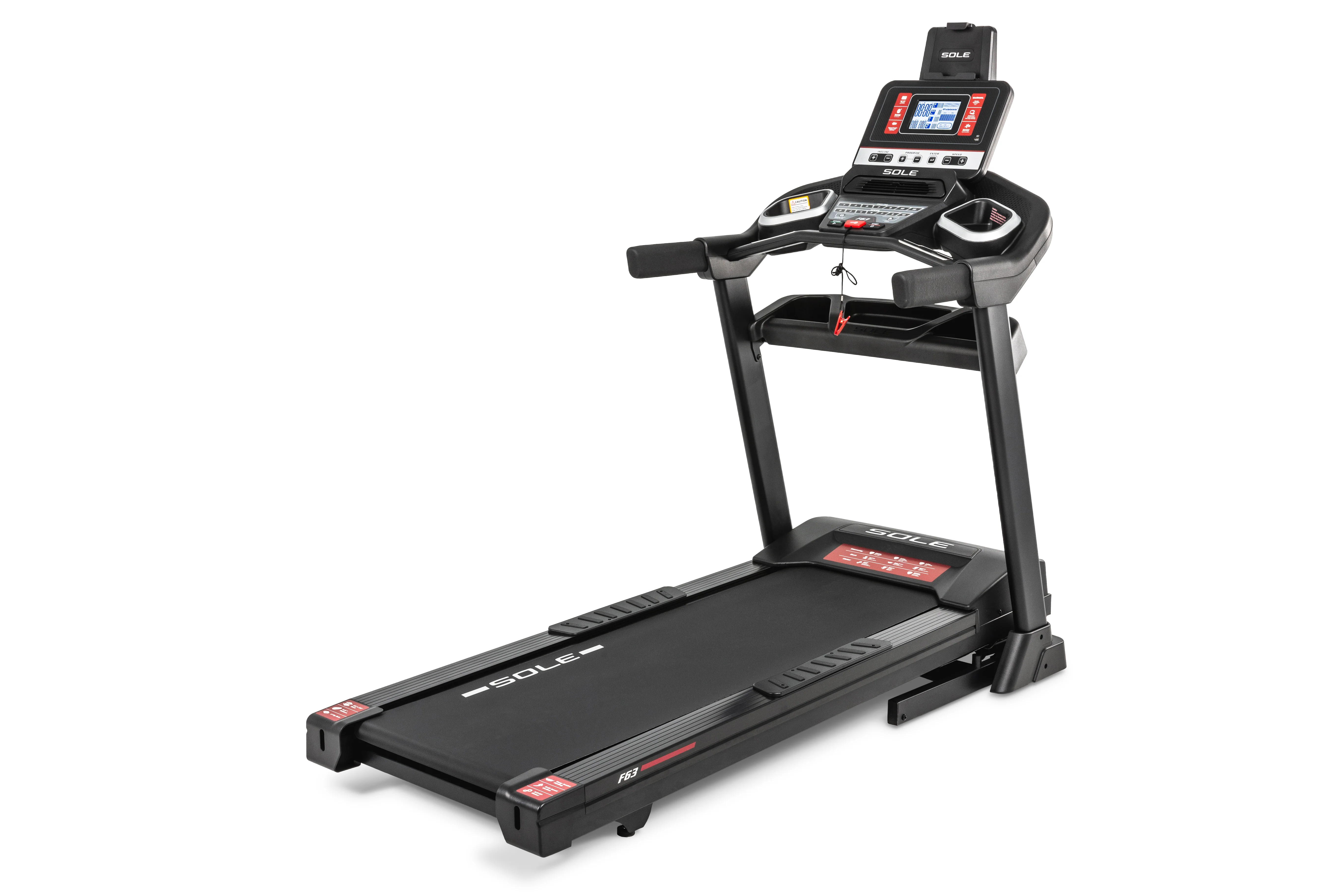
The Sole F63 is the model most buyers should inspect first because it shows the brand's value proposition clearly. Sole lists a 3.0HP motor, 0.5-12 MPH speed range, 15 incline levels, 20 x 60 inch running surface, 325 lb weight capacity, kick-release folding, USB-A charging, Bluetooth speakers, and a 6.5 inch backlit LCD. The warranty section lists lifetime frame and motor coverage, with 2 years on deck, parts, and wear items, plus 1 year of labor.
For walkers, incline users, and casual joggers, that is a strong starting spec. Good Housekeeping's 2026 treadmill guide frames the F63 as a dependable choice for beginners or casual runners, noting its speed range, incline levels, LCD tracking, tablet holder, USB charging, and Bluetooth speakers. The same publication's folding treadmill guide says the F63 feels more like a traditional treadmill than an ultra-compact folding unit, which is useful if stability matters more than tiny storage.
The limitation is speed and intensity. SELF's folding treadmill coverage says testers found the F63 intuitive and practical, but also noted that it could feel a little shaky at faster paces starting around 9 MPH. That does not disqualify the F63 for walking or moderate jogging. It does mean runners who plan frequent speed work should compare the F80 before choosing the cheaper model.
F80: The Better Middle Choice for Regular Use
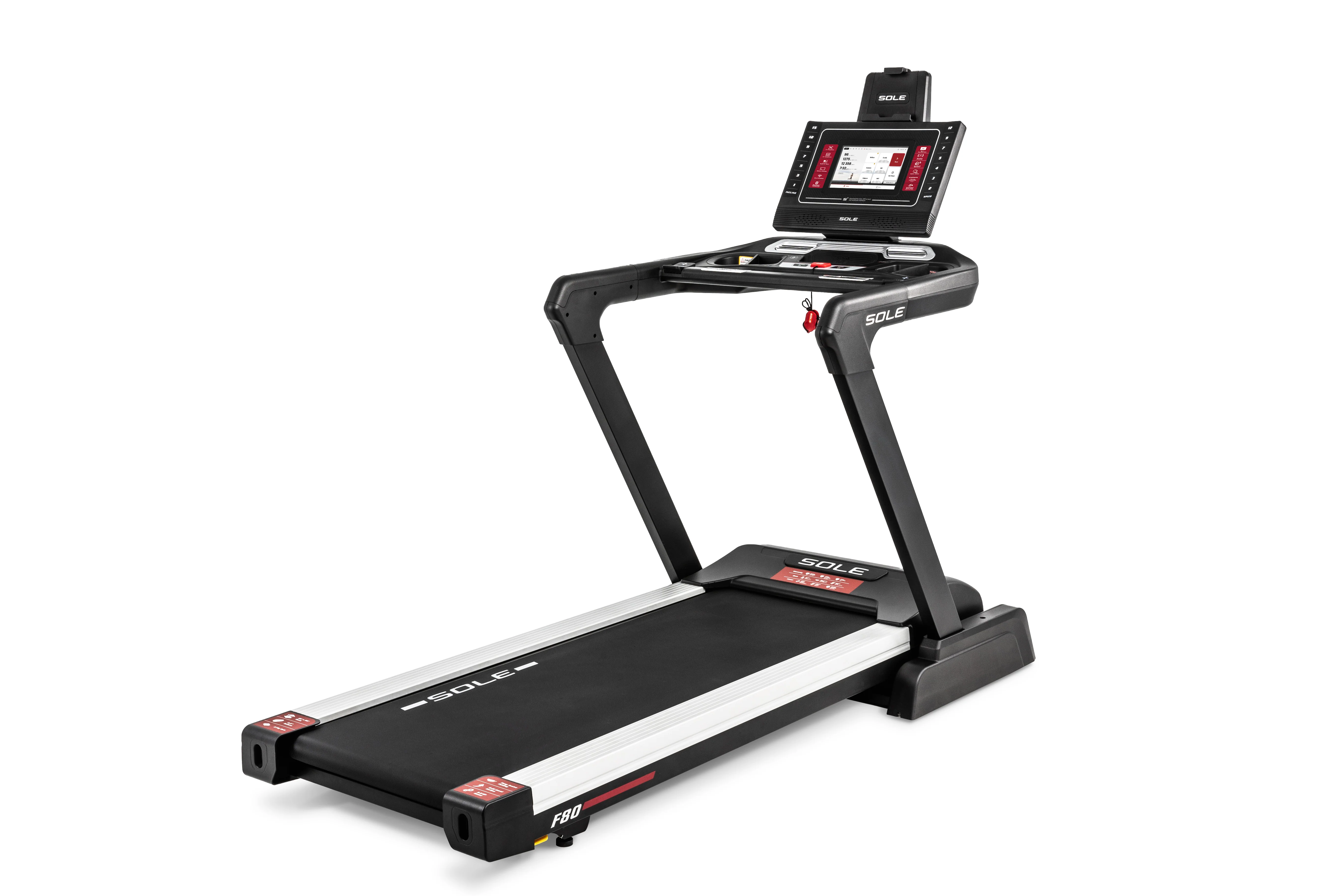
The F80 is the model that makes the most sense for many shared homes. Sole lists a 3.5 CHP motor, 10.1 inch touchscreen, 0.5-12 MPH speed range, 15 incline levels, 22 x 60 inch running surface, 350 lb weight capacity, wireless charging, Wi-Fi, preloaded apps, Bluetooth speakers, and Sole+ integration. It also has lifetime frame and motor coverage, with 3 years on deck, parts, and wear items, plus 1 year of labor.
The practical upgrade is not just the screen. The wider 22 inch deck gives runners more lateral room than the F63's 20 inch deck, and the 350 lb listed capacity gives shared households more margin. Sole also states that the F80 supports streaming apps and phone mirroring, which makes it easier to use your own content or training plan instead of paying for a single closed class library.
Choose the F80 if two or more people will use the treadmill, if you run more than casually, or if you want a machine that feels less like an entry point and more like a long-term fixture. Skip the F80 if your main use is slow walking and your room barely fits a full-size treadmill. In that case, the F63 or a compact walking pad may be the more honest purchase.
F85: The Upgrade for Heavier Use and Decline Training

The F85 is the strongest fit when the treadmill will see frequent running, multiple users, or heavier-duty demands. Sole lists a 4.0 CHP motor, 15.6 inch touchscreen, 0.5-12 MPH speed range, 15 incline levels, 6 decline levels, 22 x 60 inch running surface, 2.75 inch rollers, 375 lb weight capacity, wireless charging, Wi-Fi, preloaded apps, Bluetooth speakers, and Sole+ integration. The official page also lists assembled dimensions of 82.5 x 38 x 66 inches and item weight of 294 lb, so this is not a light piece of equipment.
The F85's real reason to exist is not that everyone needs a bigger screen. It is the combination of higher capacity, larger rollers, decline range, and heavier build. If you train frequently, share the machine with a larger household, or specifically want downhill simulation, the F85 has a clearer case. If you mostly walk, jog, or do steady incline sessions, the F80 is likely the more balanced upgrade.
One caution: the F85's official page includes magnetic-field warnings for wireless charging and implanted medical devices. The F80 page has the same warning. That is not unique to Sole, but it belongs in the buying checklist for any household where a pacemaker, defibrillator, insulin pump, or similar device is relevant.
F63 vs F80 vs F85: Quick Comparison
| Model | Better fit | Deck | Motor | Capacity | Screen | Key tradeoff |
|---|---|---|---|---|---|---|
| Sole F63 | Walkers, incline users, casual joggers, lower budget | 20 x 60 in | 3.0HP | 325 lb | 6.5 in LCD | Best value, but less ideal for frequent fast running |
| Sole F80 | Regular runners, shared homes, buyers wanting a stronger middle choice | 22 x 60 in | 3.5 CHP | 350 lb | 10.1 in touchscreen | Better long-term fit, but larger and more expensive |
| Sole F85 | Heavy use, multi-user households, decline training, bigger screen needs | 22 x 60 in | 4.0 CHP | 375 lb | 15.6 in touchscreen | Strongest specs here, but easy to overbuy for casual use |
The cleanest way to choose is to ignore the screen for the first five minutes. Start with body size, running speed, weekly use, delivery path, and who else will use the treadmill. If the treadmill is mainly for walking while studying, the F63 is enough for many buyers. If it will support regular running and family use, the F80 is safer. If you need decline training or the highest listed capacity in this group, the F85 is the logical upgrade.
Subscription Freedom Is Useful, but It Is Not the Whole Decision
Sole's no-required-subscription pitch is a real advantage for buyers who dislike locked ecosystems. A treadmill should not become unusable because you stopped paying for classes. The F80 and F85 official pages highlight entertainment apps and mirroring options, and the F63 supports simpler media use through a tablet holder, USB charging, and Bluetooth speakers.
Still, do not buy Sole only because it avoids a required subscription. Buy it because the hardware matches your use. If you love instructor-led classes and leaderboard-style motivation, compare Peloton, NordicTrack, and other connected treadmills before deciding. Sole's strength is giving you a capable treadmill that can fit into your own content habits, not forcing you into its own training world.
Space, Delivery, and Ownership Checks Before You Buy
A treadmill spec sheet can hide the real ownership problem: getting the machine into the room and keeping it pleasant to use. Check the assembled footprint, folded footprint, item weight, boxed dimensions, step-up height, and nearby power outlet. The F80 and F85 are both listed at more than 270 lb item weight, and the F85 is listed at 294 lb. That matters for stairs, basements, apartments, and upstairs rooms.
Also check the floor. A treadmill mat can reduce vibration, protect flooring, and make cleaning easier, but it does not turn every upstairs room into a perfect gym. If noise matters, avoid putting the treadmill directly over a bedroom, office, or shared ceiling. If the household includes very early or late workouts, stability and vibration may matter more than the entertainment screen.
Finally, verify current price and warranty terms on the official product page before ordering. Sole's pages show sale prices, regular prices, protection plan offers, and delivery upgrades that can change. Treat any price in a review as a timestamped reference, not a permanent buying fact.
Who Should Buy a Sole Treadmill?
Buy a Sole treadmill if you want a full-size home machine, prefer open workout habits, and care about deck size, weight capacity, and warranty positioning. The brand is especially compelling for people who already know how they want to train: walking meetings, incline walks, steady jogging, winter running backup, or a shared household cardio station.
Do not buy Sole if you need an under-desk treadmill, a tiny apartment machine, or a studio-class coaching experience as the main product. Also pause if you have not measured the room. A treadmill that is technically good but physically annoying will not become part of a weekly routine.
Internal Reading for Home Routine Buyers
If you are still shaping a home routine around work, school, and family use, read our Sole treadmill fit guide, our Sole treadmills home training review, our Planner 5D review for room planning, and our Movavi academic review for study and lesson-creation workflows.
FAQ
Are Sole treadmills good for walkers?
Yes. The F63 is the most practical Sole starting point for walkers because it has a full 20 x 60 inch belt, incline levels, simple controls, and a lower price than the touchscreen models. If the treadmill will be shared by heavier users or regular runners, compare the F80 before buying.
Are Sole treadmills good for running?
They can be, especially the F80 and F85. The F63 can handle casual running on paper, but SELF reported that testers found it could feel shaky at faster paces. Frequent runners should look closely at deck width, weight capacity, motor rating, and household use before choosing.
Do Sole treadmills require a subscription?
No required treadmill subscription is one of the brand's clearest advantages. Sole promotes free Sole+ access and built-in or mirrored entertainment options on higher models. Third-party apps may still charge separately if you choose to use them.
Which Sole treadmill is the best value?
For many walkers and casual joggers, the F63 is the value choice. For regular runners or shared homes, the F80 often makes more sense because of its wider deck, stronger motor, higher capacity, touchscreen, and longer deck and parts coverage than the F63.
Is the Sole F85 worth it over the F80?
The F85 is worth considering if you need the 375 lb listed capacity, 4.0 CHP motor, 2.75 inch rollers, decline range, or 15.6 inch touchscreen. If you do not need those upgrades, the F80 is likely the cleaner purchase.
What should I check before ordering?
Measure the delivery path, room footprint, folded storage area, ceiling clearance, and floor stability. Then verify current price, shipping, delivery upgrades, warranty terms, and medical-device warnings on the official product page.
Bottom Line
Sole Treadmills are most persuasive when judged as durable home fitness equipment rather than entertainment hardware. The F63 is the sensible entry point for walking and light running. The F80 is the strongest middle choice for regular use. The F85 is the upgrade for heavier training and decline work. Choose by routine and room fit first; the screen should come later.
Title Candidates
- Sole Treadmills Review for Walkers and Runners
- Is a Sole Treadmill Worth It for Home Training?
- Sole F63 vs F80 vs F85: Which Fits Your Routine?
- Before You Buy a Sole Treadmill, Check These Tradeoffs
- The Practical Sole Treadmills Review for Shared Homes